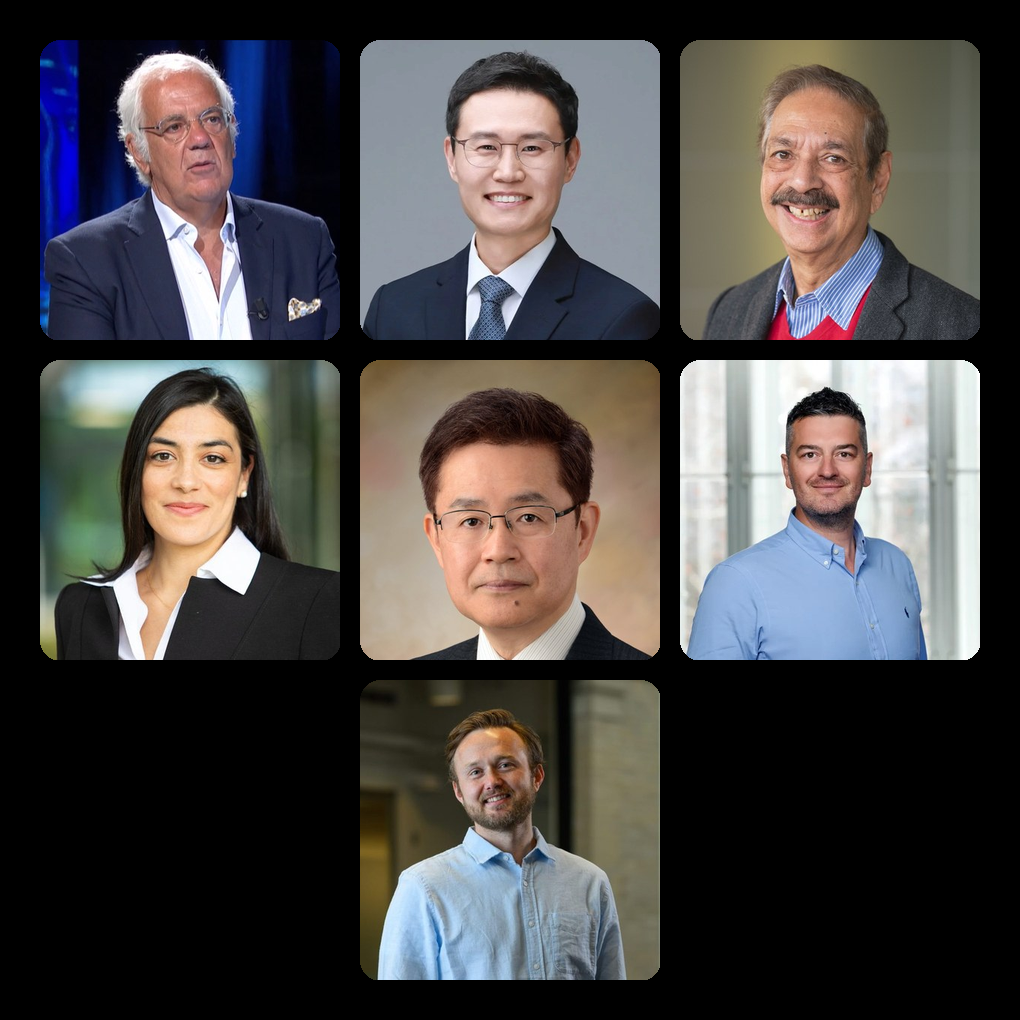
Distinguished Lecture Series Archive 2024
Distinguished Lecture Series Archive 2024
Fall Semester
2024-09-20 - Shoji Takeuchi (University of Tokyo)
Biohybrid Robotics: Revolutionizing Robotics with Living Systems
Abstract
Humanity has developed various technologies to meet societal needs, from humanoid robots and smartphones to self-driving cars. However, despite these advances in engineering and robotics, we have not yet fully harnessed the unique functionalities found in nature, such as molecular recognition, material production, and self-organization, for robotic applications. Replicating these exceptional natural capabilities in robotic systems presents significant challenges. One promising approach is the integration of biological components with artificial materials to create biohybrid robots. These biohybrid robotics can be categorized into four key areas: (i) biohybrid sensors, which detect target molecules with high selectivity and sensitivity, (ii) biohybrid reactors, which mimic biological reactions for applications like drug testing or tissue engineering, (iii) biohybrid actuators, which enable energy-efficient motion, and (iv) biohybrid processors, which perform low-energy, highly parallel computing, akin to the human brain. This presentation explores how these biohybrid technologies can be integrated in robotics to leverage the unique advantages of living systems and push the boundaries of robotic design and application.2024-10-04 - Amanda Prorok (University of Cambridge)
Synthesizing Multi-Agent Policies with Graph Neural Networks: From Cooperative Robot Perception to Human-Led Fleet Control
Abstract
How are we to orchestrate large teams of robots? How do we distill global goals into local robot policies? And how do we seamlessly integrate human-led fleet control? This talk presents data-driven approaches to learning interaction strategies that lead to coordinated and cooperative robot behaviors. It introduces the use of Graph Neural Networks and differentiable communication channels for multi-agent policy learning. Experimental results include cooperative perception, formation control, and human-led path-finding with mobile robots, and show scaling to very large systems and complex close-proximity quadrotor flight interactions.2024-10-18 - Alicia Casals Gelpi (Universitat Politecnica de Catalunya)
Robotics: A Long Way from Industrial Applications to the Operating Room. Needs and Challenges.
Abstract
Based on four decades of research, this talk traces progress from industrial automation to surgical robotics. It discusses how robotics evolved with advances in sensing, actuation, interfaces, AI, and environment-aware design, and why application-specific requirements continue to drive new technical needs. It also addresses levels of automation and human-robot cooperation across autonomous, teleoperated, and cooperative workflows, and closes with technology transfer lessons from company creation.2024-11-01 - Margarita Chli (University of Cyprus)
Vision-based Robotic Perception: Are We There Yet?
Abstract
Vision is central to how robots interpret situations and navigate. This talk reviews progress from the Vision for Robotics Lab at ETH Zurich and the University of Cyprus, and highlights major remaining challenges in robust vision-based robotic perception.2024-11-15 - Darwin Caldwell (Italian Institute of Technology)
Can Robotics and Wearable Technology Improve Health and Healthcare?
Abstract
Healthcare pressures from aging populations, workforce shortages, and demand for better outcomes motivate new approaches in robotics and wearables. This talk presents technologies developed at IIT for surgical assistance and intervention, including telesurgery, laser microsurgery, smart cannulization, and smart probes. It also covers prevention of work-related musculoskeletal disorders through exoskeleton systems and discusses where and how these technologies can deliver better patient and clinician outcomes.2024-11-29 - Amos Matsiko (Science Robotics, AAAS)
What to Consider When Writing a Research Article for Science Robotics
Abstract
Targeted at early career researchers, this presentation provides an overview of the Science journal family and major editorial criteria used in article decisions. It also highlights practical writing considerations that improve clarity and accessibility of submissions.2024-12-13 - Martin Kaltenbrunner (Johannes Kepler Universitat Linz)
Sustainable Solutions for Soft Robotic Systems
Abstract
Soft robotics can support sustainability if key challenges are solved: green high-performance materials, end-of-life strategies, and energy efficiency. This talk presents bioderived and biodegradable materials and fabrication methods, including stretchable biogels and degradable elastomers for resilient but trigger-degradable systems. It further discusses biodegradable electronics, batteries, and electrohydraulic actuators with high field tolerance and long cycle life, plus concepts for energy-autonomous aquatic and aerial soft robots.Source: ETH Soft Robotics Lab Distinguished Lecture Series Archive.
| ← Back to Archives | Current Talks |