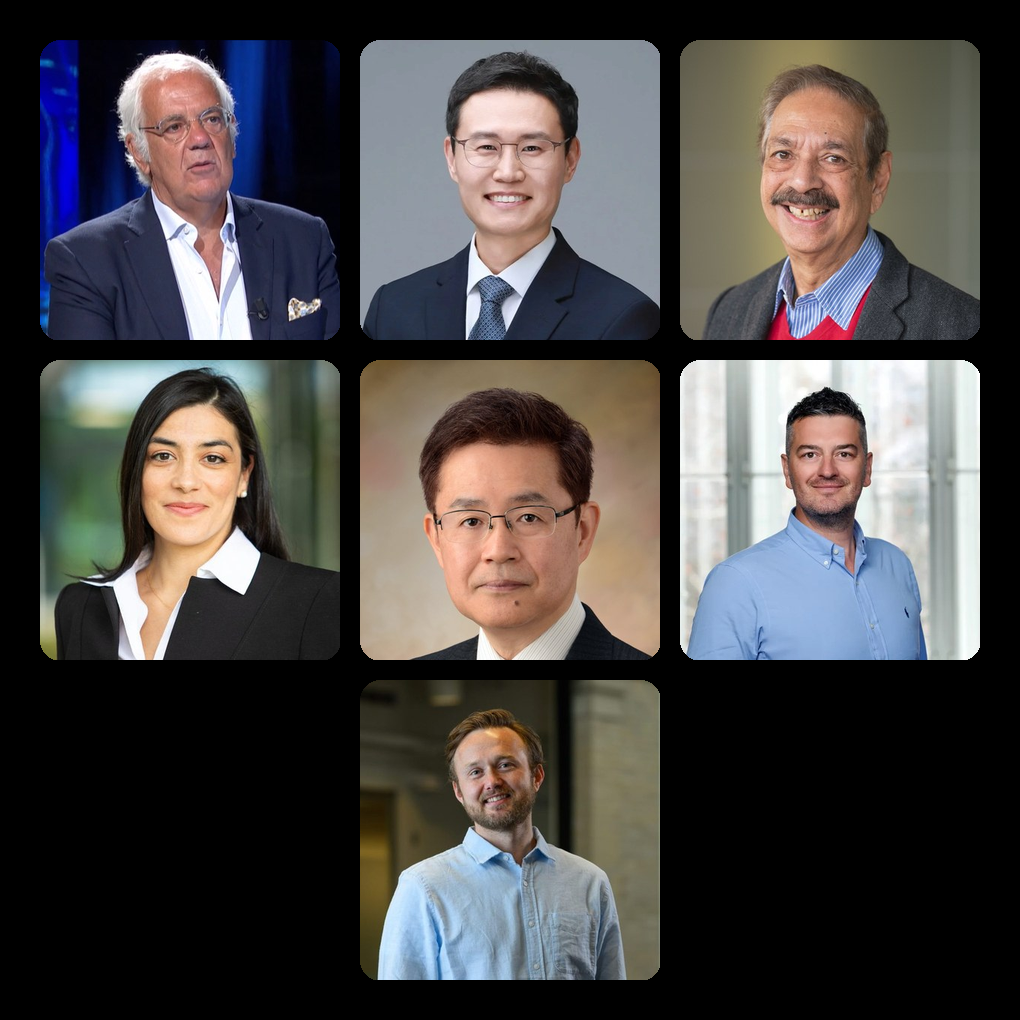
Distinguished Lecture Series Archive 2021
Distinguished Lecture Series Archive 2021
Fall Semester
2021-09-24 - Bradley Nelson (ETH Zurich)
Combating COVID-19: The Role of Robotics in Managing Public Health and Infectious Diseases
Abstract
Robotics has a central role in infectious disease response, from prevention and monitoring to care, lab automation, logistics, and continuity of socioeconomic activity. This talk reviews robotic technologies for pandemic management and discusses renewed interest in telesurgery under pandemic constraints.2021-10-08 - Yu Sun (University of Toronto)
Micro-NanoRobotics: from Robotic Cell Surgery to Intracellular Manipulation
Abstract
Manipulating micro/nanoscale objects enables new possibilities in surgery, diagnostics, industry, and basic science. This talk reviews field evolution and presents challenges, opportunities, and advances in precision instrumentation, sensing, actuation, and control. It includes robotic cell surgery/drug-screen systems and sub-micrometer position plus sub-nanoNewton force control for 3D intracellular and intra-tissue manipulation.2021-10-22 - Arianna Menciassi (Scuola Superiore Sant’Anna)
Implantable BioRobotic Organs
Abstract
The talk introduces implantable biorobotic organs (IBROs), fully implantable systems with sensing, actuation, and cognition for closed-loop support of biological processes. It examines engineering challenges beyond prostheses and semi-implantables and presents case studies from Scuola Superiore Sant'Anna.2021-11-05 - Chelsea Finn (Stanford University)
Broad Robot Generalization by Reusing Broad Data
Abstract
Robot learning has achieved complex manipulation skills, but broad generalization remains a challenge. This talk advocates continuous reuse of broad offline datasets across tasks, robots, and human video data instead of single-lab online-from-scratch training. It presents zero-shot results over 100 tasks and evaluations focused on generalization to unseen objects, scenes, views, and tasks.2021-11-19 - Fumiya Iida (University of Cambridge)
Bio-Inspired Soft Robotics x AI
Abstract
Soft robotics enables rich adaptive behaviors but introduces difficult sensing, modeling, planning, and control problems due to continuum mechanics and diverse interactions. This talk presents projects combining soft robotics and machine learning to address these complexity challenges.2021-12-03 - Bram Vanderborght (Vrije Universiteit Brussels)
Soft and Self-Healing Actuators for Human Robot Collaboration
Abstract
This talk presents self-healing soft robotics based on Diels-Alder polymers for safer human-robot collaboration in health and manufacturing. It covers multi-material synthesis, strong interfacial bonding across contrasting moduli, and manufacturing methods including reactive 3D printing. Demonstrators include self-healing grippers and hands with embedded sensors and heaters.2021-12-17 - Stefan Leutenegger (Technical University of Munich)
Spatial AI for Mobile Robots
Abstract
Despite progress in localization, mapping, and scene understanding, robust deployment in open-ended environments remains difficult. This talk discusses hybrid paradigms that combine modular perception-action pipelines with learned sub-tasks. Applications include drone navigation and control with emphasis on spatial representation, robustness, failure identification, and recovery.Source: ETH Soft Robotics Lab Distinguished Lecture Series Archive.
| ← Back to Archives | Current Talks |