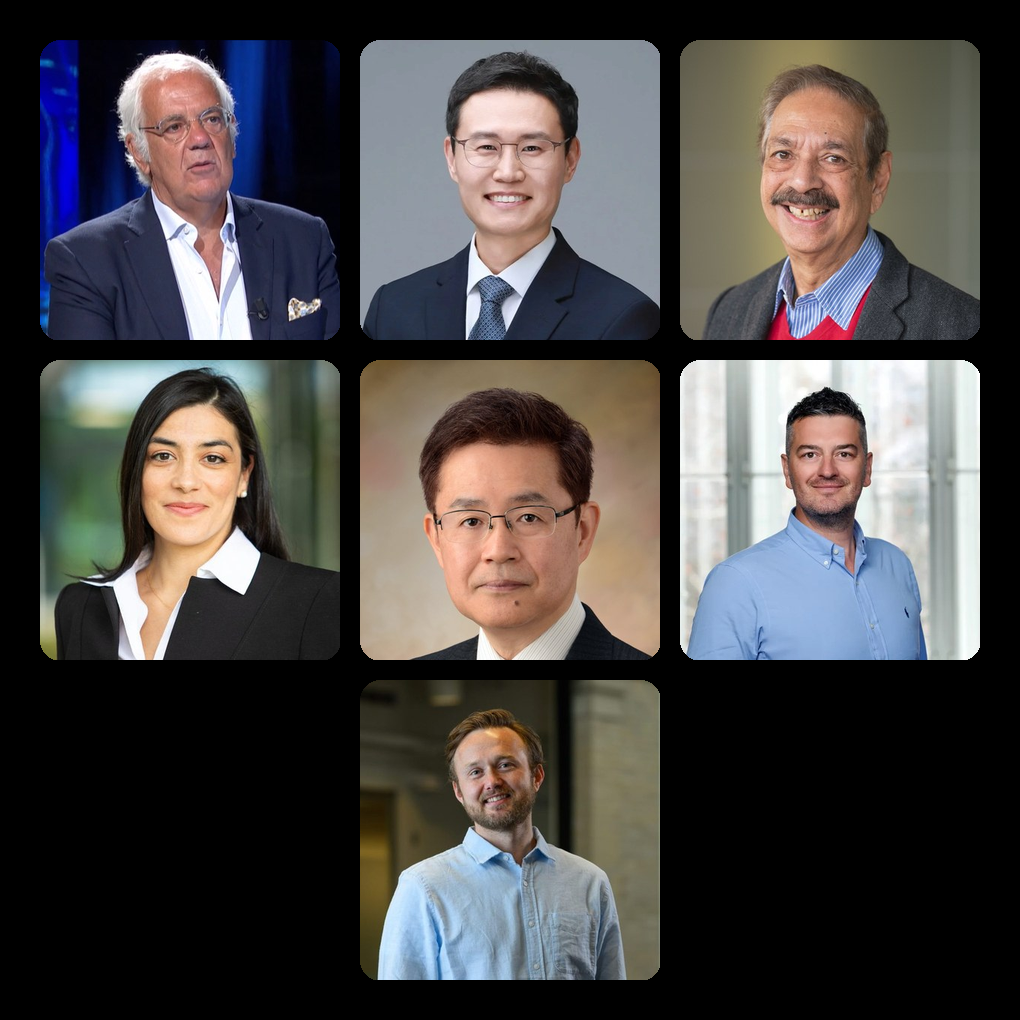
Distinguished Lecture Series Archive 2019
Distinguished Lecture Series Archive 2019
2019-02-22 - Sethu Vijayakumar (University of Edinburgh)
Shared Autonomy: The Future of Interactive Robotics
Abstract
As robots increasingly collaborate with humans, other robots, and environments, paradigms shift to shared control with robot autonomy and human high-level supervision. This talk presents machine learning technologies for robust multimodal sensing, shared representations, real-time adaptation, and compliant actuation scheduling. It also asks what autonomy-control trade-off humans are comfortable with across self-driving, offshore, mining, manufacturing, rehabilitation, and smart city domains.2019-03-08 - Karl H. Johansson (KTH Royal Institute of Technology)
Control of Automated Transport Systems
Abstract
Road freight is critical but energy intensive. This talk discusses integrated automated goods transport from individual long-haul trucks to fleet-level optimization and logistics. It highlights platooning benefits, automated-driving regulatory impacts, and multi-level control/optimization problems. A communication-enabled architecture (V2V/V2I) for robust and safe truck/fleet control is illustrated with extensive European highway experiments.2019-03-22 - Helge Wurdemann (University College London)
Soft Material Robotic Structures: Inherently Soft - Inherently Safe
Abstract
Soft-material robots differ fundamentally from rigid-link systems and are increasingly relevant across healthcare, industry, and autonomous driving. This talk presents examples including minimally invasive stiffness-controllable manipulators and large structures for human-autonomy interaction in vehicles. It discusses scalability, stiffness control, and modeling challenges plus future opportunities.2019-04-05 - Dirk Lefeber (Vrije University Brussel)
Compliant Actuation Principles for Rehabilitation and Assistive Robots
Abstract
Conventional electric actuators have limitations for assistive robotics (inertia, stiffness, safety, efficiency). This talk presents adaptable compliant actuation with intrinsic mechanical compliance, yielding bandwidth-independent safe behavior. Potential benefits include reduced power needs, improved efficiency, and safer prosthetic/rehab/assistive systems, with emphasis on series-parallel elastic architectures.2019-05-03 - Heike Vallery (TU Delft)
Robotic Augmentation of Human Locomotor Capabilities
Abstract
Wearable robotics promises major gains but conventional approaches remain cumbersome. This talk advocates complementary designs that avoid overlapping with retained human motor function to improve usability and function. Examples include trunk-oriented balance assistance via wearable gyroscopic actuators and lightweight designs for prosthetics, gait training, and orthopedic/neurological support.2019-05-17 - Sami Haddadin (TUM)
Machine Intelligence: Bridging the Gap Between Robotics and AI
Abstract
Breakthroughs in robotics and AI have enabled flexible, human-centered systems usable by non-experts. This talk discusses remaining grand challenges to unified machine intelligence: advancing embodied sensory-motor design and unifying model-based control with data-driven learning for seamless physical-virtual integration.2019-05-24 - Guy Dumont (UBC)
Towards Safe Closed-Loop Control of Anesthesia
Abstract
Closed-loop anesthesia has been studied since 1950 but is not yet standard clinical practice. This talk focuses on safety-by-design engineering under large inter/intra-patient variability, robust control guarantees, safety-preserving fallback modes, and human-computer interaction for safe clinician takeover. Examples come from UBC's iControl TIVA closed-loop system.Source: ETH Soft Robotics Lab Distinguished Lecture Series Archive.
| ← Back to Archives | Current Talks |