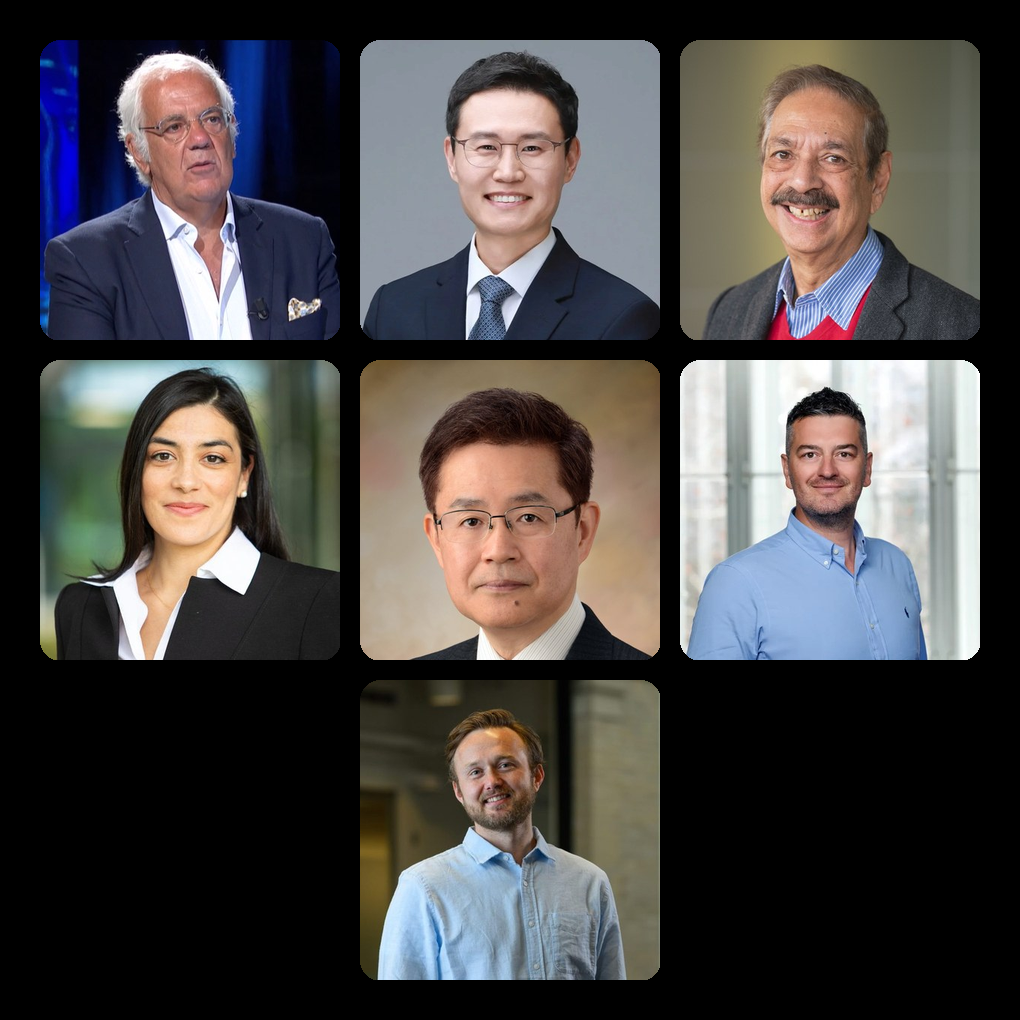
Distinguished Lecture Series Archive 2015
Distinguished Lecture Series Archive 2015
2015-09-18 - Gaurav S. Sukhatme (University of Southern California)
Robots at Sea: From Drones to Autonomy
Abstract
This talk reviews advances in autonomous underwater robotics at USC, focusing on persistent systems and adaptive sampling problems such as underwater change detection and biological sampling. It also discusses hazard avoidance for operations in areas with heavy ship traffic.2015-10-02 - Barbara Mazzolai (Istituto Italiano di Tecnologia)
Learning from Nature How to Build Soft Robots
Abstract
Robots operating in uncertain environments benefit from bioinspired soft-robotics principles. This talk compares animal- and plant-inspired paradigms for movement, sensing, and control, emphasizing decentralized, modular, resilient plant strategies alongside traditional animal models.2015-10-16 - David Reinkensmeyer (UC Irvine)
Robotics and Wearable Sensors for Neurorehabilitation
Abstract
Robotic therapy now includes diverse devices and algorithms, but optimization principles remain incomplete. This talk presents clinical testing, motor-learning studies, and computational neurorehabilitation work toward an integrated framework across motor learning, neural plasticity, and human-robot interaction. It also introduces new rehabilitation devices and wearable sensors developed within this framework.2015-10-30 - Sabine Hauert (University of Bristol)
From Swarm Robotics to Nanomedicine
Abstract
Nanoparticles for cancer are increasingly mobile, sensing, and interactive, motivating swarm-robotics methods for controlling large populations of limited-capability agents. This talk presents swarm-strategy design in realistic simulation and translation to physical robot swarms and tissue-on-chip systems.2015-11-13 - Hansjorg Scherberger (German Primate Center)
Grasp Predictions from Motor, Premotor, and Parietal Brain Areas
Abstract
This talk presents findings on how primate AIP, F5, and M1 brain areas generate grasping and how grasp can be decoded from neural spiking data using implanted arrays. It discusses implications for understanding motor networks and developing neural interfaces for restoring hand function.2015-11-27 - Auke Ijspeert (EPFL)
Neuromechanical Models of Locomotion: From Biology to Robotics
Abstract
Locomotion control in animals relies on spinal circuits including central pattern generators and reflexes. This talk shows oscillator-based models of lamprey/salamander spinal circuits tested on amphibious robots, providing hypotheses on gait transition, sensory integration, and motor-skill generation. Extensions to biped locomotion and human locomotion control roles are also discussed.2015-12-11 - Marcie O’Malley (Rice University)
Challenge and Engagement: Ensuring Effective Upper Limb Robotic Rehabilitation
Abstract
This talk presents methods to ensure appropriate challenge and active patient engagement in upper-extremity robotic rehabilitation after stroke and incomplete spinal cord injury. It covers objective motor assessments, engagement-enforcing control architectures, capability-adaptive controllers, and clinical evaluation findings.Source: ETH Soft Robotics Lab Distinguished Lecture Series Archive.
| ← Back to Archives | Current Talks |