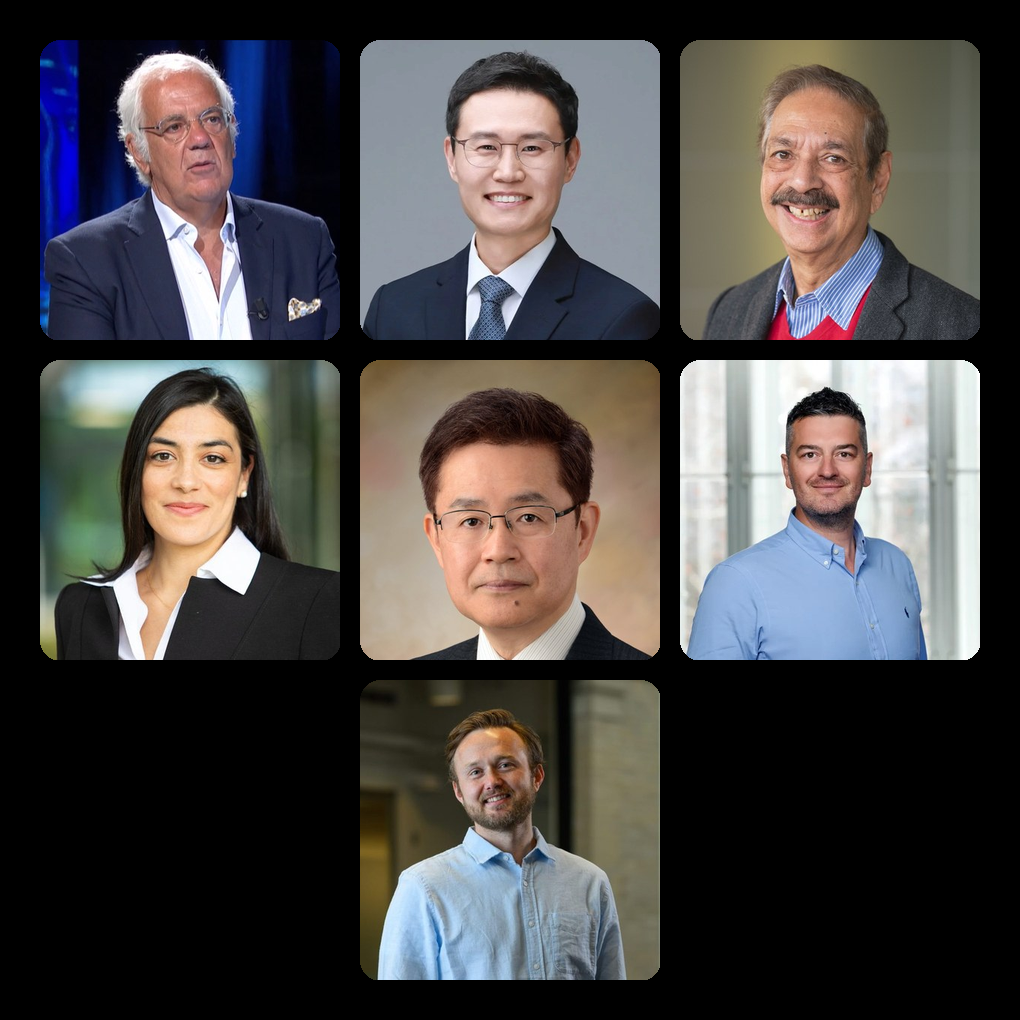
Distinguished Lecture Series Archive 2014
Distinguished Lecture Series Archive 2014
2014-09-26 - Hermann van der Kooij (University of Twente)
Advances in Wearable Exoskeletons for Assistance of Human Gait
Abstract
This talk provides an overview of recent advances in lower-limb wearable exoskeletons for strength augmentation, assistance, and therapy across populations including stroke survivors, children with cerebral palsy, and spinal cord injured patients.2014-10-03 - Metin Sitti (Max Planck Institute)
Small-Scale Mobile Robotics
Abstract
Untethered small-scale mobile robots can access confined spaces noninvasively and could be agile, low-cost, and mass-producible. This talk covers design, fabrication, and control of miniature robots using advanced and soft materials for healthcare, bioengineering, sensing, micromanufacturing, and inspection.2014-10-17 - Oliver Brock (TU Berlin)
Soft Manipulation: Staying in Touch to Get a Grip
Abstract
Human manipulation relies heavily on environmental contact, unlike conventional robot approaches. This talk presents a new grasping/manipulation strategy inspired by human behavior.2014-10-31 - Michiel van de Panne (University of British Columbia)
Designing Motion Skills Using Physics-Based Simulation and Optimization
Abstract
This talk reviews capabilities and future prospects of physics-based simulation and numerical optimization for skilled motion in humans, animals, and robots, and discusses how these tools can connect robotics, animation, and biomechanics.2014-11-14 - Guang-Zhong Yang (Imperial College London)
Robotic Surgery - Current State-of-the-Art and Future Directions
Abstract
Surgery is being transformed by advances in robotics, imaging, and minimally invasive techniques. This talk reviews current surgical robotics, key barriers such as cost/footprint/complexity, and research directions including robotic platforms under development at the Hamlyn Centre.2014-11-28 - Jan Peters (TU Darmstadt)
Motor Skill Learning: From Simple Skills to Table Tennis and Manipulation
Abstract
Autonomous daily-life assistance requires scalable learning methods for high-dimensional robots. This talk presents a general motor-skill learning framework in robotics based on principles behind analytical approaches.2014-12-12 - Gordon Cheng (TU Munich)
Interaction Between Humanoid Robotics and Neuroscience
Abstract
This talk presents a robotics direction that links advances in humanoid systems with neuroscience, highlighting how robots can serve both industrial applications and neuroscience discovery.Source: ETH Soft Robotics Lab Distinguished Lecture Series Archive.
| ← Back to Archives | Current Talks |